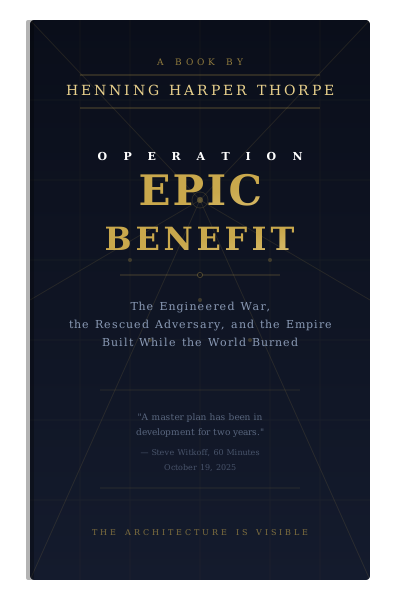
A New Book by Independent Journalist Harper Thorpe
Operation Epic Benefit — book cover

The War Was the Point.

The chaos is the cover. Independent journalist Harper Thorpe reveals the architecture connecting the Iran war, the Ukraine “peace,” the Gaza reconstruction, and the seizure of Venezuela into a single designed system — and identifies who it was built to benefit.

157 pages. 19 chapters. Five theaters. One architecture.

Predictive record96.2%Resolved entries53 / 51Anomalies1
Operation Epic Benefit — book cover
Publication Date TBD. A publisher is being selected. The manuscript is complete and available under NDA. The Architecture Monitor — the book's weekly analytical supplement — is live now and publishing every Tuesday.
The Synopsis

The Gaza reconstruction plan preceded the destruction it was designed to address.

Operation Epic Benefit was written during an active war, but it's not a retrospective. It documents the role the war plays in a larger architecture designed to benefit a specific network of actors — not countries — whose gains will likely be irreversible regardless of who wins the next election. The book's analytical framework (The Architecture) asserts the Iran war was not a diplomatic failure or the byproduct of an impulsive administration's chaotic foreign policy. It was the plan.

These are not conspiracy theories. The book builds an architectural analysis across five different theaters entirely on public evidence, congressional testimony, government documents, financial disclosures, and timestamped transcripts.

The President of the United States committed $10 billion in public funds to an institution he personally chairs for life, in his private capacity, with no congressional approval. The president sent money to himself.

That is not a metaphor. It is the documented financial record. The reader is not asked to trust the author — only to evaluate the evidence and reach their own conclusion. Then to ask why no one with subpoena power has done so yet.

Every day the Iran war continues, it produces elevated oil prices that rescue Russian revenues, infrastructure destruction that generates reconstruction mandates worth hundreds of billions, and European energy dependency that fractures the Western alliance. According to the architecture, the delay in resolving the conflict is not diplomatic failure or incompetence.

The delay is the strategy.

The Architecture Monitor, a weekly supplement to the book, tracks real-world developments against the book's public predictions in real time. No other published analysis of the Iran war has subjected itself to live, falsifiable testing at this standard. And it's passing.

But the clock is running. The architecture does not pause for those who are not paying attention. The outcomes are accumulating. And the window for accountability is closing.

Latest Issue

The Architecture Monitor

A weekly briefing that tests the book's analytical framework against the unfolding record.

Issue 13 · July 21, 2026Confirmed

The Loop and the Pivot

In the week the Monitor recorded its first prediction falsification — 11-1 closed July 21 with no Iran nuclear talks initiated or scheduled, against a backdrop of nightly U.S. infrastructure strikes expanded to bridges, airports, and power grids, confirmed American service member casualties, and Moody's Analytics projecting approximately $150 billion in domestic economic cost (~$1,100 per household) — the Monitor documented two structurally significant pattern disclosures: the Iran theater's two-instrument toolkit (military strikes and economic sanctions) operating against a regime whose foundational institutional identity is resistance to Western capital has produced a loop that replicates the functional signature of attrition without bearing the design signature of strategy, while the Ankara NATO summit's Patriot PAC-3 MSE production license — a transfer Trump simultaneously refused to make from existing U.S. stockpiles, explicitly citing Iran-theater depletion as the reason — disclosed the administration's recognition of an asymmetry its own Iran impasse made visible: Russia's stability-dependent authoritarian model cannot indefinitely absorb military stagnation and economic attrition the way the Islamic Republic absorbs them, and the Monitor reads the Ankara pivot as the behavioral evidence of that recognition, timed explicitly to a November midterm clock that the Iran theater — absent a negotiated off-ramp — cannot serve.

Read Latest Brief →